6 Global Shockwaves Rocking Indonesia’s Insurance Sector
Admin
Writer
23 September 2026
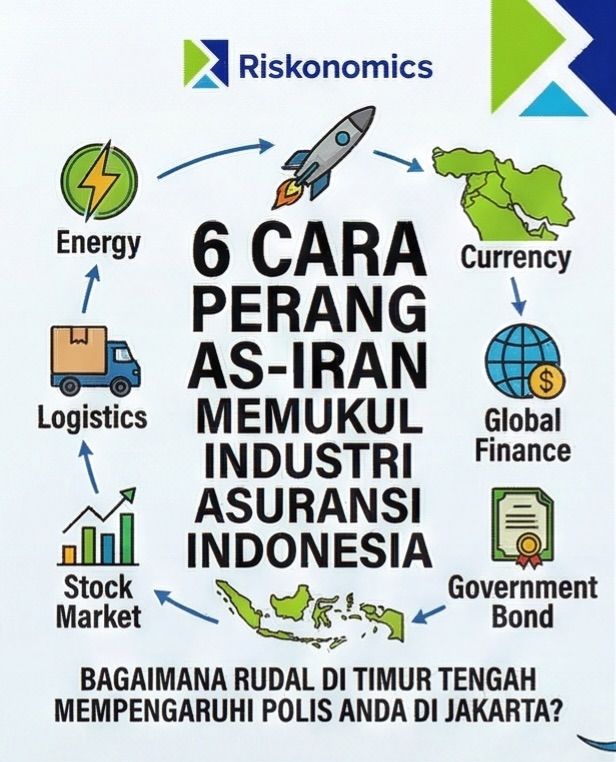
How do missile strikes in the Middle East affect your insurance policy in Jakarta? As it turns out, the answer lies in 6 simultaneous pathways driven by macroeconomic and geopolitical domino effects.
Here is how the global situation impacts your insurance policies in Jakarta, right at a time when the domestic industry is already under pressure from regulatory and claims crises:
1. 🛢️ Rising Oil Prices, Strained State Budget (APBN)
Conflicts near major supply routes trigger a spike in global crude oil prices. As a net oil importer, Indonesia faces a ballooning energy subsidy bill, which strains the State Budget (APBN). The resulting domestic inflation drives up living and operational costs, ultimately reducing public purchasing power for new insurance products.
2. 💱 Weakening Rupiah, Surging Reinsurance Costs
Global uncertainty prompts investors to move their capital into safe-haven assets like the US Dollar. Consequently, the Rupiah weakens. For insurance companies in Jakarta, this depreciation is a heavy blow because international reinsurance premiums—which are mostly denominated in foreign currencies—become significantly more expensive.
3. 🚢 Disruptions in the Strait of Hormuz, Skyrocketing Marine Cargo Claims
The Strait of Hormuz is a vital trade artery for global oil and logistics. When security risks escalate due to missile threats, transit risks spike. Insurance companies face a surge in marine cargo claims due to delays, damages, or cargo losses, which will eventually force a hike in shipping insurance premium rates.
4. 🔒 Hardening Global Reinsurance Market
High geopolitical uncertainty forces global reinsurance companies to tighten their capacity. This triggers a hardening market phenomenon, where international reinsurers raise premium rates, tighten policy terms and conditions, and restrict risk coverages. Local insurers in Jakarta are left with no choice but to accept these costlier terms to offload their large risks.
5. 📉 Dropping JCI, Eroded Stock Portfolios
Market panic over the conflict triggers sell-offs in the domestic capital market, causing the Jakarta Composite Index (JCI / IHSG) to drop. Insurance companies place a large portion of their managed funds (customer premiums) into stock instruments. When the JCI plummets, their investment portfolio value erodes, potentially threatening their financial health and solvency ratios (Risk-Based Capital).
6. 📊 Government Bonds Losing Value
Beyond stocks, fixed-income instruments like Government Bonds (SBN) are also taking a hit. As inflation looms and interest rates are pressured to rise to defend the Rupiah, bond prices in the secondary market fall. This reduces the value of the secure investment assets held by insurance firms.
The Double Whammy on the Domestic Insurance Industry
These external shocks hit even harder because the Indonesian insurance industry is currently battling two major domestic challenges:
The Medical Claims Crisis (MSCI): Skyrocketing medical inflation (Medical Standard of Care Inflation) has caused health insurance claim ratios to swell significantly over recent years.
Capital Pressures from POJK 23/2023: The Financial Services Authority (OJK) mandates a gradual increase in minimum equity requirements for insurance firms. Against a backdrop of eroded investment markets due to global conflicts, meeting this capital requirement has become a matter of survival for many local insurers.